
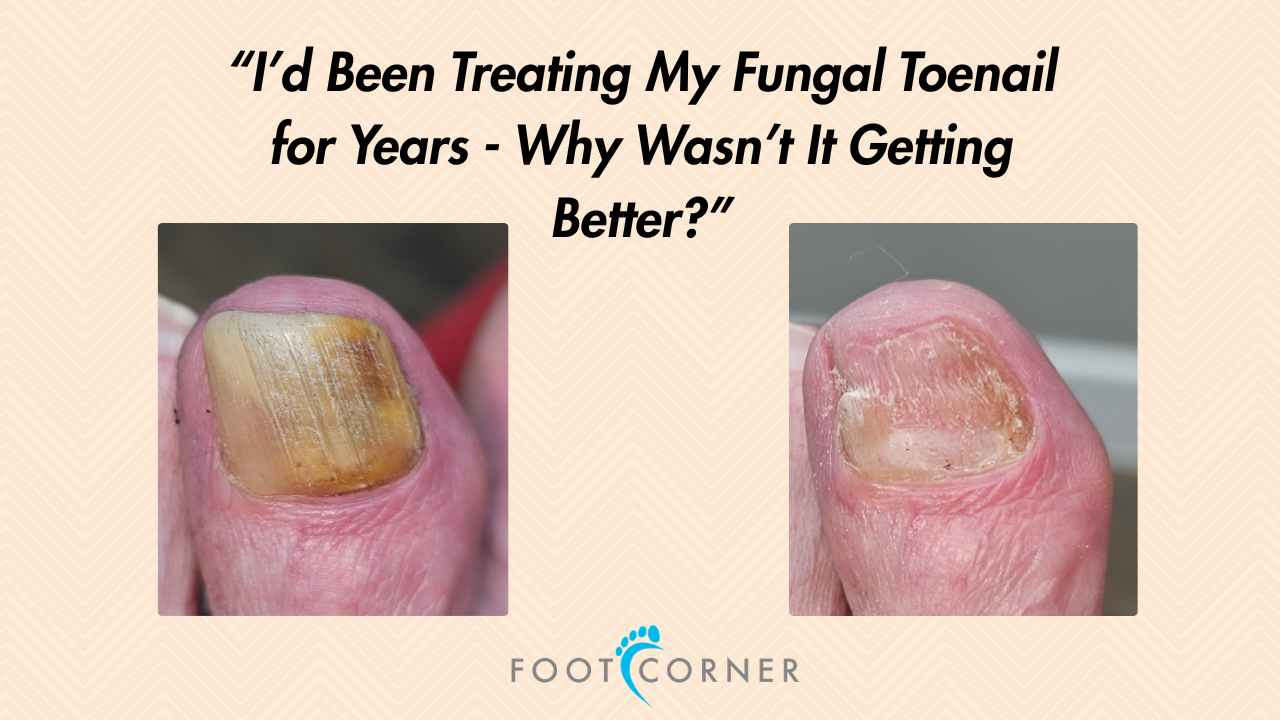
“I’d Been Treating My Fungal Toenail for Years – Why Wasn’t It Getting Better?”
Aug 11, 2026Fungal toenails can be incredibly frustrating.
You apply a treatment for weeks. Then months. Sometimes even years.
You think you can see a little improvement, but the nail remains thick, discoloured and unhealthy-looking.
This was exactly what happened to a gentleman who recently visited us at Foot Corner in Ashford, Surrey.
He had been trying to treat a fungal infection in his big toenail for around three to four years.
But despite his persistence, it simply wasn't clearing.
“I Was Told to Just Live With It”
Before visiting Foot Corner, the patient had already spoken to his GP about the toenail.
As the nail wasn't causing him any significant medical problems, he had essentially been reassured that it wasn't doing him any harm and that he could simply live with it.
And for a while, he did.
But then something changed.
He noticed that another toenail, his right big toenail was beginning to show signs of fungal infection too.
That concerned him.
He didn't want to simply wait and watch it potentially spread to more nails.
He wanted to understand why his treatment hadn't worked and what else he could do.
So he booked an appointment at Foot Corner for some professional advice.
Sometimes We Need to See What's Happening Underneath the Nail
When we examined his toenail, it was extremely thick and had significant changes consistent with a longstanding fungal nail problem.
Rather than simply recommending another product for him to apply, we wanted to understand what was actually happening underneath the nail.
We recommended cutting and reducing the affected nail back as much as possible.
The aim was to remove the thick, damaged nail material and expose the area underneath so that we could properly assess the extent of the problem.
In his case, much of the affected nail was no longer properly attached to the nail bed.
This meant we were able to remove the loose, diseased nail without causing him pain.
And once the nail had been reduced, we could see something very important.
The Problem Wasn't Just on the Surface
From the outside, the nail looked badly affected.
But underneath, we could see that the fungal changes extended into the area beneath the thickened nail and involved the surrounding skin/nail bed area.
Suddenly, it became much clearer why years of home treatment had achieved so little.
The patient had been trying to treat the problem from the top of an extremely thick toenail.
But the treatment needed to reach the areas where the infection was actually present.
Think of it a little like trying to treat something underneath a thick protective shield.
You can keep applying treatment to the surface, but if very little of it reaches the area underneath, it may struggle to have the desired effect.
Why Can Fungal Nail Treatments Fail?
This is something we see quite regularly at Foot Corner.
People sometimes tell us:
“I've been using fungal nail treatment for years and nothing seems to work.”
That doesn't necessarily mean they haven't been applying it correctly.
There can be several reasons why treatment isn't succeeding.
A fungal nail may become extremely thick. There may be a large amount of infected or damaged nail present. The infection may involve the skin around or underneath the nail, or the topical treatment being used may simply struggle to penetrate through the nail sufficiently.
There may also be other factors contributing to reinfection including fungal infection of the skin, footwear, socks or the environment.
And importantly, not every thick, yellow or damaged toenail is necessarily fungal.
This is why professional assessment can be useful, particularly when a nail problem has been present for a long time or hasn't responded to treatment.
We Could Finally Create a Proper Treatment Plan
Once we had reduced the patient's nail and could properly see the extent of the problem, we were able to give him much more specific advice.
Instead of continuing to repeatedly apply treatment to a very thick nail and hoping it would eventually work, we could create a treatment plan based on what we could actually see.
This included advice on caring for the nail and surrounding skin, reducing the risk of reinfection and using appropriate treatment consistently.
And then came the rewarding part.
When We Saw Him Again, the Difference Was Remarkable
At his follow-up appointment, the area had responded extremely well.
The fungal infection had cleared and the nail area looked completely different.
After spending around three to four years trying to deal with the problem himself, he finally understood why his previous treatments had struggled and what needed to be done differently.
For us, this case wasn't simply about treating a fungal toenail.
It was about finding out why the problem wasn't improving.
Don't Assume You Have to Live With a Fungal Toenail
If you've had a fungal toenail for months or even years, it's very easy to become frustrated.
You may have tried:
- fungal nail paints
- pharmacy treatments
- creams
- filing the nail
- cutting it yourself
- treatments bought online
And perhaps you've reached the point where you've decided nothing is going to work.
But sometimes the problem isn't that fungal nails can't be treated.
It's that the right area isn't being reached, the nail hasn't been adequately reduced, the diagnosis needs confirming, or the treatment plan isn't appropriate for the extent of the infection.
That is why an assessment can make such a difference.
Fungal Nail Treatment at Foot Corner, Ashford
At Foot Corner in Ashford, Surrey, our experienced podiatrists regularly assess patients who have been struggling with fungal or suspected fungal toenails.
Depending on what we find, treatment and management options may include:
- Professional reduction of thickened fungal nails
- Removal of loose or severely affected nail where clinically appropriate
- Advice on topical antifungal treatments
- Advice regarding oral antifungal medication through your GP where appropriate
- Fungal nail testing where the diagnosis is uncertain
- Advice on treating fungal infection of the surrounding skin
- Footwear, sock and hygiene advice to help reduce reinfection
- Laser treatment for suitable fungal nail cases
- Nail removal so it regrows again
- A personalised treatment plan and follow-up
There isn't one treatment that's right for every fungal nail.
The first step is understanding what is actually happening to your nail and why it isn't improving.
Have You Been Treating a Fungal Toenail That Just Won't Clear?
If you've been applying treatment for months or even years without seeing the improvement you hoped for, you don't necessarily have to simply live with it.
Sometimes taking away the thickened, damaged nail and properly assessing what is happening underneath can completely change the approach to treatment.
Contact Foot Corner in Ashford, Surrey to arrange an appointment with one of our experienced podiatrists.
We can assess your toenail, explain what may be happening and discuss the treatment options that may be suitable for you.
15 Church Parade, Ashford, Surrey, TW15 2TX
01784 250 781 or Book Online Here
